How Autessa Runs Its Entire Business on Autessa
We are our own first customer. Every conversation, every candidate, every deal, and every decision runs on the same platform we sell — including the moments that commitment gets tested.
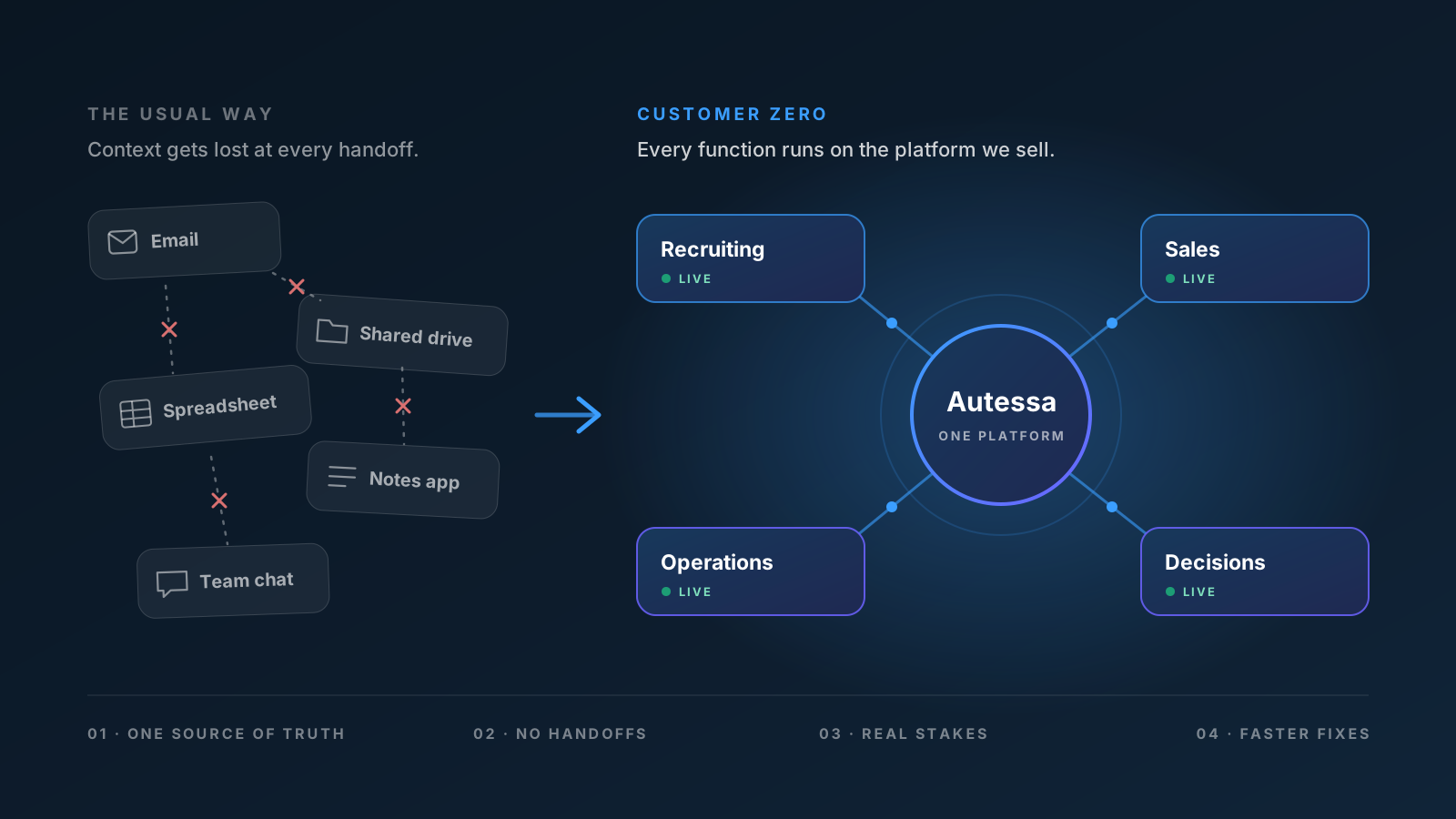
We are our own first customer. Every conversation, every candidate, every deal, and every decision all runs on the same platform we sell. This is not a testing exercise or a cultural gesture. Autessa is the system that runs our business. If it stops working, our business stops working.
We have written separately about what customer zero is and why it matters for platform companies. This piece is about what customer zero looks like in practice when an AI platform company commits to running everything on its own product, including the moments where that commitment gets tested.
What does running everything on one platform actually look like?
Most platform companies have a dirty secret. They do not use their own product for anything that matters. The demo environment is pristine. The production environment that runs the actual business is Gmail, Notion, a shared Google Drive, and a spreadsheet someone started eighteen months ago that now holds together half of operations.
We decided early that Autessa would not be that company. Every business function at Autessa runs on Autessa, not as a demo, not alongside a safety net, but as the actual, only system. Our data lives in AutessaDB. Our agents handle real operational work. Prism evaluates their output. Lens interacts with the tools we have not built integrations for yet. Forge builds the internal applications we need as we need them.
When a recruiter finishes a candidate call, the conversation record goes into AutessaDB. When a sales meeting ends, the notes, commitments, and next steps go into AutessaDB. When the team needs to understand pipeline health or hiring progress or operational bottlenecks, they query Autessa. There is no context lost in the handoff between where work happens and where data lives because there is no handoff.
Running everything on a single platform means every question you ask has the full picture behind it, not just the sales picture or the recruiting picture, but the whole picture.
How does Autessa use its own platform for recruiting?
Recruiting is a process that generates enormous amounts of qualitative information and then loses most of it. A hiring manager speaks to eight candidates over two weeks. By the time they sit down to make a decision, the early conversations are a blur. The notes are scattered. The comparison is based on feeling, not evidence.
At Autessa, every candidate conversation is captured and stored in AutessaDB as structured, queryable data that agents can reason about. The data is not a transcript dumped into a folder that nobody opens. It is a living record that gets more useful over time.
This means we can ask questions that would be impossible in a traditional recruiting workflow. Which candidates raised concerns about our stage or runway, and how did we address those concerns? Did we consistently explain the equity structure, or did three candidates get different versions of it? Across all the interviews for this role, did we actually assess the competencies we said mattered, or did the conversation drift into other areas every time?
These are not hypothetical questions. They are real questions we ask, and the answers change how we recruit. When an agent surfaces that we forgot to cover a specific topic with two out of six candidates, we fix it before making a decision with incomplete information. When the agent identifies that every candidate in a pipeline flagged the same concern, that finding is a signal about how we are positioning the role, not just a data point about one person's hesitation.
The compounding effect is significant. Every hiring round makes the next one better because the patterns are visible and queryable, not trapped in someone's memory.
What happened when the sales team tried an external CRM?
This story is worth being honest about because it reveals something important about what working on Autessa actually feels like day to day.
A few months in, our sales team started looking at external CRM platforms. The motivation was understandable. They wanted intelligent pipeline views, deal tracking, and the kind of polished interface that established CRM products ship out of the box. They did not want to spend time designing what that should look like inside Autessa. They wanted something that worked immediately, with opinions already baked in about how a pipeline should be structured and displayed.
So they tried it. They moved their workflow into an external CRM for about two weeks.
What happened was instructive. The tool was well-designed and opinionated, which was the initial appeal. But being opinionated cuts both ways. The data model was prescribed. The views were prescribed. The way deals related to conversations and contacts and activities was prescribed. When the team wanted to change how something worked or see the data from a different angle, they hit walls. They did not hit bugs. They hit the natural constraints of a product built around someone else's assumptions about how sales should work.
The frustration was not that the tool was bad. The frustration was that the team had been spoiled. Working inside Autessa means nothing is prescriptive. The data structure is yours. The interface is yours. The relationships between entities are defined by what your business actually needs, not what a product team in another company decided was the default. When you want to change something, you change it. When you want a new view, you describe it and Forge builds it. There is no ticket to file, no feature request to submit, and no workaround to engineer because the platform assumes a different workflow than yours.
After two weeks, the sales team came back and rebuilt the entire CRM workflow inside Autessa. They designed the data structure they actually wanted, with deals connected to conversations, contacts, meeting notes, commitments, and follow-ups in exactly the relationships that reflected how they sell, not how a generic CRM thinks they should sell. They designed the views they wanted, arranged the way they wanted, showing the information they cared about. The whole process took less time than the two weeks they had spent trying to adapt to the external tool.
That experience became a reference point inside the company. It became a reference point not because external tools are bad, but because once you have worked in a system where the data model, the interface, and the intelligence layer are all yours to define, going back to a prescribed product feels like a constraint you did not realise you had accepted.
How does the sales workflow operate now?
A deal involves multiple conversations spread across weeks or months. Each conversation generates commitments, objections, technical questions, and signals about what the buyer actually cares about. In most organisations, that context lives in a CRM record that contains a one-line summary written by whoever remembered to update it.
At Autessa, the full context of every deal conversation flows into AutessaDB. When we prepare for a follow-up meeting, an agent can surface exactly what was discussed, what was promised, what technical concerns were raised, and what the prospect said they would do next. The agent provides the actual substance, not a summary written after the fact.
This approach changes the quality of follow-up conversations. We walk in knowing what was committed on both sides. When a prospect said they needed to run the security review past their CISO, we know that happened and we can ask about the outcome specifically. When a technical evaluation was agreed on, we can reference the exact scope that was discussed rather than a vague recollection of it.
We can also ask questions across the pipeline that would require hours of manual analysis otherwise. Which objections come up most frequently and at what stage? When deals stall, what was the last topic discussed before they went quiet? Are we consistently reaching the right stakeholders, or are we having productive conversations with people who do not have decision authority?
The agents are not replacing judgment. They are making sure the judgment happens with complete information instead of fragments.
When does Autessa use external tools, and why?
Running on Autessa is not a dogma. It is a discipline. The discipline is simple: if someone wants to bring in an external tool, the question is why. That question is not a bureaucratic gate. It is a genuine forcing function for clarity. What does this tool do that Autessa cannot or should not do? If the answer is clear and honest, we use the external tool without hesitation.
We use GitHub for code hosting. GitHub handles private repositories, dependency scanning, and the entire ecosystem of tooling that developers expect. We would not want to store source code inside our own file system and build those capabilities ourselves. That is not our problem to solve, and GitHub solves it well.
We use Gusto for payroll. Payroll involves tax compliance, benefits administration, and legal liability that shifts meaningfully when a dedicated provider handles it. The reason to use Gusto is not convenience. The reason is that the liability model is fundamentally different when a specialist owns it.
In both cases, the answer to "why not Autessa?" is immediate, specific, and grounded in something real. That clarity is the point.
What the discipline prevents is the opposite scenario, where someone reaches for an external tool out of habit or impatience when the actual reason is "I don't want to spend an afternoon setting it up here." That is the instinct that fragments data, creates governance gaps, and slowly rebuilds the exact infrastructure sprawl that Autessa exists to eliminate. The CRM experiment was a perfect example. The team reached for an external tool because it looked faster. Two weeks later, they had less flexibility, less integration, and had lost time rather than saved it.
The rule is not "always use Autessa." The rule is "know exactly why you are not using Autessa." That distinction keeps the platform honest and keeps the team from sleepwalking into the fragmented tool sprawl we help our customers escape from.
How does constraint drive product innovation at Autessa?
This constraint is also where a surprising amount of product innovation comes from. When the team cannot default to an external tool without a clear justification, the natural response is to push the platform. The sales team did not just rebuild a CRM inside Autessa. They built a better one than they would have bought, because the platform let them design around how they actually work. Features that started as internal solutions to our own problems have become core parts of the product. When you force yourself to live inside the system, you find its edges faster, and you extend them in ways that matter.
The builders are the users. The friction they encounter is real. The improvements they make are grounded in actual need, not speculative feature requests. The product converges toward something genuinely useful because it is being shaped by genuine use.
The difference at Autessa is scope. Slack used Slack for messaging. Shopify used Shopify for commerce. Those are single-function products used for their intended purpose. Autessa is a platform that spans data, agents, evaluation, perception, and application building, and we use every module, every day, for every function of the business. The surface area of internal use is the full surface area of the product.
How does Autessa handle internal operations on its own platform?
Every company generates operational data that could improve decision-making if anyone could find it and make sense of it. Meeting outcomes, project status, resource allocation, and internal requests all accumulate across dozens of tools and channels and become effectively invisible within weeks.
When all of that data lives in one system, the operational questions become straightforward. What did we commit to this week, and did we deliver on last week's commitments? Where are we spending time that is not translating into outcomes? Which internal processes generate the most questions, suggesting they need better documentation or redesign?
Forge handles the application layer. When the team needs a new internal tool such as a tracker, a dashboard, or a workflow, that tool gets described and deployed within the platform. There are no tickets to engineering. There is no waiting. There is no separate system to maintain. The tool lives where the data lives, which means it is always current and always connected to the full context.
Why does this matter if you are evaluating Autessa?
We find the problems first. When AutessaDB query performance degrades under a specific pattern of concurrent requests, we hit it before a customer does. When an agent makes a reasoning error because a capability definition is ambiguous, we experience the consequence in our own workflow. When Prism scoring reveals a blind spot in how an agent evaluates a conversation, we see it in our own evaluation data.
The system you are evaluating is the same system that runs the company that built it. The data model, the agent architecture, the evaluation framework, and the governance controls are not just tested in a lab. They are tested against real business operations, continuously, with real consequences for failure.
A company that runs its own business on a different stack is telling you, through its choices, that the product is not ready for the work that matters most. We run everything on Autessa because the platform is ready, and because running everything on it is what keeps it that way.
We are the most demanding customer Autessa has. That is by design, and it is why the platform is as good as it is.