What Is Customer Zero, and Why Do the Best Platform Companies Practice It?
Customer zero means running your business on the product you sell — not as a test, but as the system of record. A look at where the idea came from and why it shapes the best platform companies.
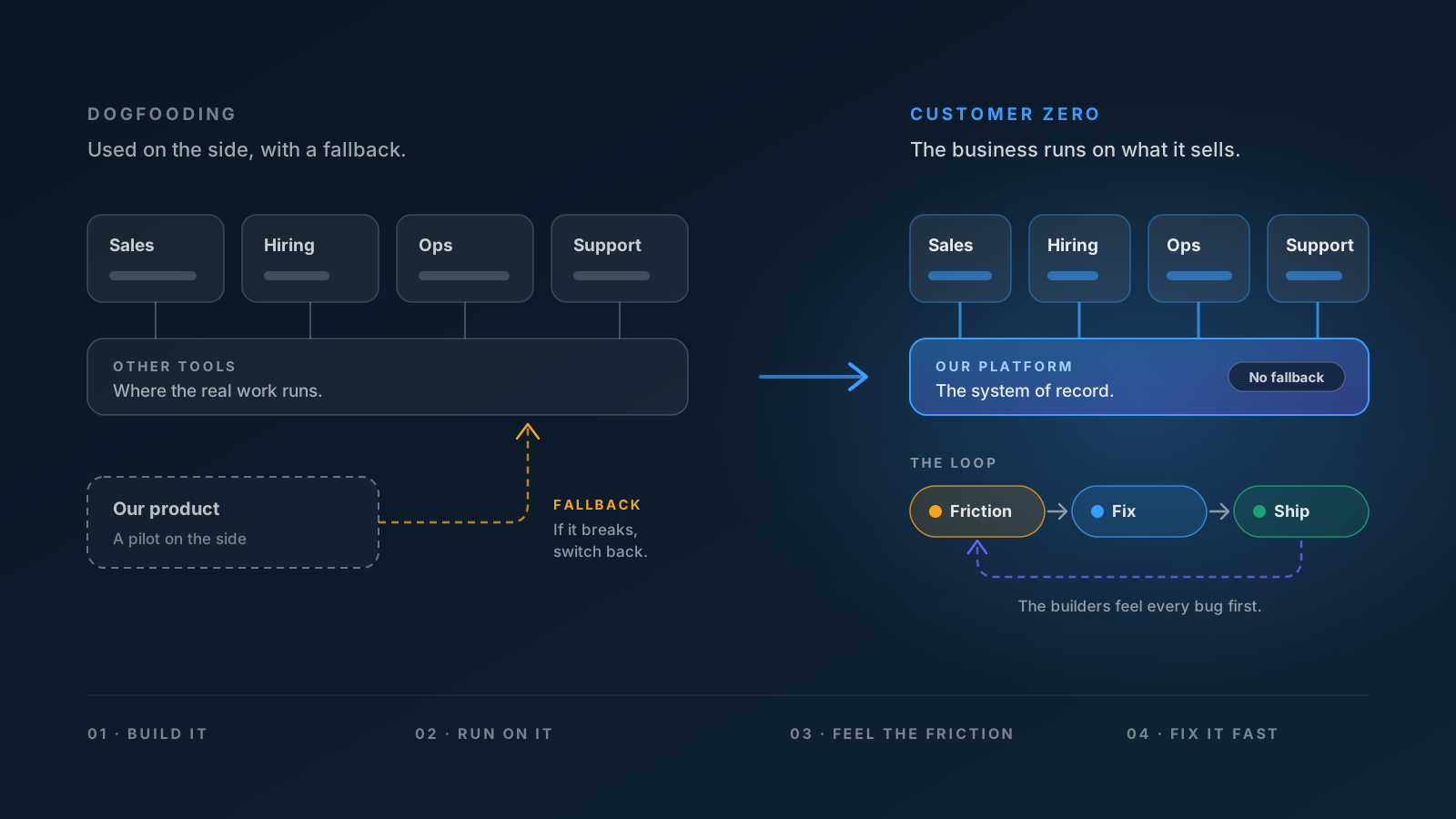
Customer zero is the practice of running your own business on the product you sell. It goes beyond testing or internal piloting. The company treats itself as the product's first and most demanding customer, depending on the platform for real work with real consequences for failure. When the people who build the product are also the people whose daily work breaks if it does not perform, the quality feedback loop is immediate, personal, and impossible to ignore.
The concept has a longer history than most people realise, and the companies that have practiced it most seriously have tended to build the most enduring products in their categories.
Where did the concept of customer zero come from?
The idea predates the term. In 1989, Donald Knuth published a paper reflecting on the development of TeX, the typesetting system he had built over the preceding decade. His conclusion was precise: the designer of a new system must also be its implementor, its first large-scale user, and the author of its first documentation. Separating any of those roles, he argued, would have cost the system hundreds of improvements that he would never have thought of or understood the importance of without direct, daily involvement.
Knuth was not making a philosophical argument. He was reporting a practical finding. Living inside TeX as both its creator and its most intensive user forced him to encounter problems that no amount of external feedback would have surfaced. The friction was personal, so the fixes were immediate.
That insight has shaped how the most important platform companies have been built since.
How is customer zero different from dogfooding?
The terms are often used interchangeably, but they describe different levels of commitment.
Dogfooding typically means a company uses its own product internally in some capacity, often as a testing exercise or a cultural gesture. The product might be used for a subset of workflows, or it might run in a controlled environment alongside other tools that handle the work that actually matters. If the product fails, the team switches to something else and files a bug report.
Customer zero means the product is the system of record. If the product fails, the business stops. There is no fallback. That distinction changes the incentive structure entirely. Bugs are not tickets to be prioritised. They are obstacles in someone's workday that demand immediate resolution. Missing features are not roadmap items. They are gaps that the team has to work around right now.
The difference is not just semantic. It determines whether internal use generates polite suggestions or urgent, high-quality product insights.
Which companies have practiced customer zero successfully?
Several of the most influential technology companies were shaped by this practice, though each arrived at it differently.
Slack
Slack was never supposed to be a product. It was an internal communication tool built by a game studio called Tiny Speck, because the team found that existing messaging software was not good enough for how they needed to work. They built what they needed, used it every day, and eventually realised the tool was more valuable than the game they were making. By the time Slack launched publicly in 2013, the product had already been shaped by months of genuine daily dependency rather than beta testing. It took eight months to reach a billion-dollar valuation.
Shopify
Tobias Lütke built an e-commerce platform because he needed one to sell snowboards online. Every early design decision was informed by the fact that the builder was also the merchant. As Lütke has said, there is no closer proximity to a customer's problem than being that customer yourself. Shopify's early product was good not because it was well-researched, but because it was well-used.
Cisco
Cisco formalised customer zero at enterprise scale, making it an explicit part of their IT mission. They deployed their own networking products internally to validate deployment guidelines, evaluate use cases, and develop operational best practices before recommending them to customers. For Cisco, being customer zero was not a cultural value. It was a methodology for producing reliable enterprise guidance.
Microsoft
When Microsoft built Windows NT, over two hundred developers ran daily builds on their own machines. When someone's code broke the build, the consequences were immediate and personal. A broken build was not an abstract bug report. It was a broken workday. That personal impact created a quality culture that no external testing process could replicate.
What are the benefits of being customer zero?
The benefits compound over time and operate across several dimensions.
The most immediate benefit is speed of feedback. When the team building the product also depends on it, problems surface in hours rather than weeks. There is no lag between a customer encountering an issue and the product team learning about it, because they are the same people. The gap between "what the product does" and "what users need it to do" stays small because the builders and the users share the same context.
The second benefit is depth of understanding. Customer research can tell you what people say they want. Being customer zero tells you what they actually need, because you experience the need yourself. Knuth's observation was that hundreds of improvements in TeX came from insights he could only have had as a daily user. No survey, interview, or usability test would have surfaced them.
The third benefit is trust. When a company runs its own business on the product it sells, it is making a credible commitment to quality. A company that runs its own business on a different stack is telling prospective customers, through its choices, that the product is not ready for the work that matters most. A company that runs everything on its own platform is telling them the opposite.
The fourth benefit is that product innovation emerges naturally from internal use. Features that start as internal solutions to real problems often become core parts of the product. The improvements are grounded in actual need rather than speculative feature requests, which means the product converges toward something genuinely useful.
What are the risks of customer zero, and how should companies manage them?
The most well-known risk is "Not Invented Here" syndrome, where a company refuses to use external tools even when they are clearly better, simply because those tools were not built in-house. Internal use can become ideological rather than practical, and the company ends up building inferior versions of things that already exist rather than focusing on what it does best.
Knuth himself avoided this trap. He built TeX for typesetting, not for everything. He used the best available tools for the tasks TeX was not designed to handle. His discipline was knowing the boundary.
The second risk is that internal users are not representative of external customers. A team of engineers building a developer tool will use it differently than a team of marketers who adopt it later. If the company only optimises for its own use patterns, the product can become excellent for a narrow audience and frustrating for everyone else.
The third risk is that internal familiarity masks usability problems. The team knows every workaround, every quirk, and every hidden shortcut. A new customer does not. If the company is not deliberately seeking external feedback alongside internal use, it can build a product that works beautifully for experts and poorly for beginners.
The healthiest version of customer zero combines deep internal use with a clear-eyed willingness to use external tools when they are genuinely better. The discipline is not "always use your own product." The discipline is "know exactly why you are not using your own product." That distinction keeps the platform honest without tipping into ideology.
Why does customer zero matter for AI platforms?
The customer zero principle takes on additional importance for AI platforms specifically, because the category is new enough that trust is scarce and the gap between demos and production is wide.
Many AI platforms can produce impressive demonstrations. Fewer can demonstrate that the underlying systems are reliable enough to run real business operations. When an AI platform company runs its own recruiting, sales, operations, and internal tooling on its own platform, it is providing the strongest possible evidence that the system works under real conditions, not just controlled ones.
The feedback loop also matters more for AI products because the failure modes are more subtle. A database either returns the right query results or it does not. An AI agent can return plausible but wrong results, miss context, or degrade in quality as conditions change. Catching those failures requires the kind of sustained, high-context use that customer zero provides. External testing and benchmarks are useful, but they cannot replicate the experience of depending on the system for work that matters.
For enterprise buyers evaluating AI platforms, a simple question cuts through the noise: does the company that built this product actually run its business on it? If the answer is yes, the product has been tested against real complexity, real stakes, and real consequences for failure. If the answer is no, the buyer should ask why.
What should you look for when evaluating a customer zero claim?
Not every company that claims to dogfood its product is practicing customer zero. There are several questions that distinguish genuine commitment from marketing language.
The first question is whether the company uses the product for its core business functions, or only for peripheral workflows. A CRM company that uses its own CRM for sales is practicing customer zero. A CRM company that uses its own CRM only for internal event tracking is dogfooding.
The second question is whether the product is the system of record, or whether there is a parallel system underneath. If the real data lives in spreadsheets, shared drives, or a different platform, the company is not depending on its own product for the work that matters.
The third question is whether the company has a clear, honest framework for when it uses external tools instead. The strongest customer zero practitioners are not ideological. They can articulate exactly why they use GitHub for code hosting or a specialist provider for payroll, and those reasons are grounded in genuine capability boundaries rather than convenience.
The fourth question is whether internal use has visibly shaped the product. You should look for features or design decisions that clearly originated from the company solving its own problems. That lineage is a sign that the feedback loop is real and active.
Knuth put it simply: if the designer is not also the first serious user, hundreds of improvements will never be made, because the designer will never understand why they matter. That insight is forty years old and more relevant than ever.