Build vs. Buy for Government AI: Why the Smartest Agencies Are Choosing Both
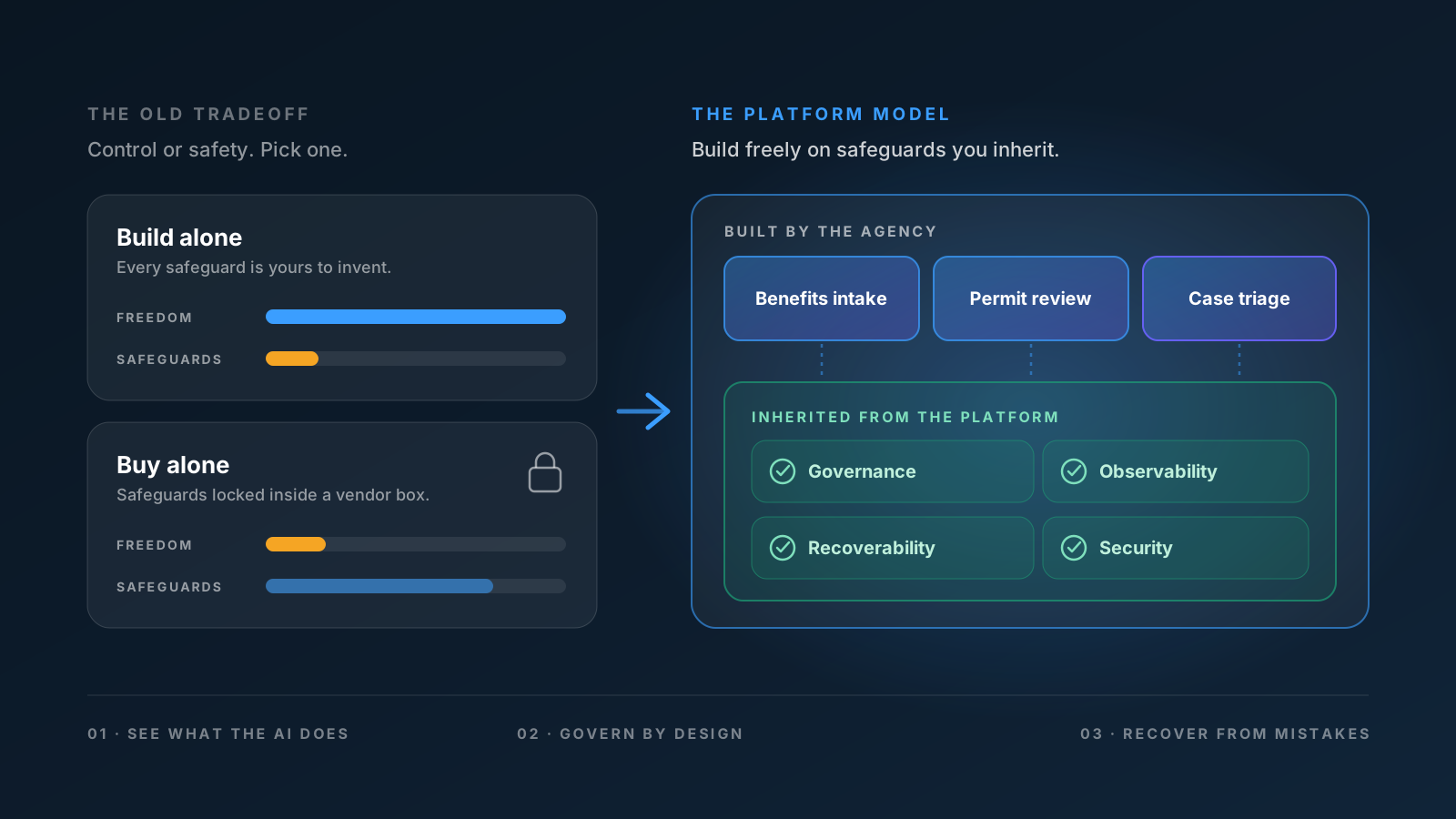
The old build-versus-buy debate assumed agencies had to trade control for safety. A platform model lets government build the applications its mission requires on top of inherited governance, observability, and recoverability.
Should a government agency build its own AI applications or buy them off the shelf?
Government agencies should do both at once. The smartest agencies no longer treat build versus buy as a choice between control and safety. They adopt a platform that lets them build the applications their mission requires while inheriting the security, governance, and reliability guarantees that buying used to provide. Autessa is built around this principle. It gives agencies the freedom to build, and it surrounds that freedom with the safeguards a government environment demands.
This is the same shift that cloud computing already proved. Before Amazon Web Services, an organization that wanted custom software had to run its own data centers, manage its own hardware, and guarantee its own uptime. AWS did not force a choice between custom applications and operational reliability. It provided an infrastructure layer, and organizations built whatever they wanted on top of a foundation that handled security, scaling, and uptime. Autessa applies that same model to government AI.
Why does the old build versus buy framing fail for AI?
The old framing fails because AI agents take actions, and actions create risks that neither building alone nor buying alone can manage. A traditional application produces an output that a person reviews. An AI agent reaches into agency systems and does things, such as updating a record, issuing a determination, or sending a notice. Once a system has hands, the important question changes. The question is no longer whether the AI gives accurate answers. The question is what the AI is allowed to do, and what happens when it does the wrong thing. Building alone leaves an agency to invent every safeguard itself. Buying alone hands those safeguards to a vendor the agency cannot fully inspect or control. A platform that separates the freedom to build from the discipline of governance resolves the tension.
What actually goes wrong with government AI applications?
Government AI deployments fail in specific and recurring ways, and most of these failures have nothing to do with model quality. They are caused by everything that surrounds the model. The sections below describe the most common failure modes.
Why can nobody see what the AI is doing?
Most agencies cannot see what their AI is doing because the systems were never built to record it. When an AI application makes a recommendation or a decision, the agency often has no systematic record of what the model received as input, what reasoning it followed, or what alternatives it weighed. When a citizen challenges a benefits determination or a journalist files a public records request, the agency cannot reconstruct what happened. Government decisions must withstand legal, public, and oversight scrutiny, so this lack of visibility is disqualifying.
Why does governance keep getting bolted on instead of built in?
Governance gets bolted on because most AI applications treat it as documentation written after the system already runs. Government operates on rules, including procurement regulations, civil rights protections, records retention laws, FISMA and FedRAMP requirements, and agency-specific policy. When these rules are not enforced at the platform level, each individual application becomes a separate compliance gap. The agency then has no way to guarantee consistent policy across the dozens of tools it deploys.
Why is there no way back when something breaks?
There is no way back because most agencies never version their AI systems in a way that makes rollback possible. AI applications drift over time. A model update changes behavior, a prompt is modified, or a data source shifts, and the system that worked last week now produces different results. Without versioned, reversible deployments, teams cannot return to a known-good state. The result is downtime, emergency patches, and erosion of public trust.
Why does nobody know whether the AI actually works?
Nobody knows whether the AI works because many agencies test it once before launch and then assume the performance holds. Model behavior changes over time, and the cases and populations an agency serves change as well. Without continuous evaluation against real-world outcomes, an agency cannot tell whether accuracy has quietly degraded, whether the system produces disparate impacts across protected groups, or whether the AI still operates within acceptable bounds.
Why does the data leave, and why does that matter?
The data leaves because many off-the-shelf tools send agency information to external systems and offer no path to building agency-specific capability. The agency becomes dependent on a vendor's general-purpose model while its own data, the most valuable asset it holds for improving performance, flows out and provides no lasting return. The agency never builds the institutional intelligence that would let it serve its specific mission better over time.
Why can nobody prove the investment was worth it?
Nobody can prove the value because most AI deployments have no built-in way to measure return on investment. Government leaders must justify spending to budget officials, oversight committees, and the public. When a deployment cannot show how much staff time it saved, how much backlog it cleared, how much it reduced error rates, or what it cost per outcome, the agency is left guessing. AI that cannot demonstrate its own value is AI that loses its funding.
Why does the connection between AI and agency systems become the weakest point?
The connection becomes the weak point because connecting AI to systems the wrong way exposes far more than the agency intends. Older approaches required a custom integration for every AI use case and every system, which produced inconsistent audit trails and high costs. Newer approaches often hand the AI a broad connection that exposes the full set of actions a system can perform. A connection to a case management system might allow the AI to read every record, create every record, delete every record, and export every record that the underlying credentials permit. The agency needs the AI to reach its systems, but a raw connection grants far too much, and that gap is where the most serious failures begin.
Why is buying a prebuilt use case the most common failure of all?
Buying a prebuilt use case fails most often because a use case trained on someone else's playbook does not know how your agency works. Many agencies purchase a finished AI solution, such as a generic benefits screener or a standard correspondence tool, and discover that it was built around another organization's rules, terminology, populations, and exceptions. The agency cannot change how it reasons, cannot align it with its own statutes and procedures, and cannot correct it when it gets the agency's specific situation wrong. The right way to think about this is to compare an AI application to an employee. An agency does not hire an employee who is permanently pretrained on another organization's playbook and who can never learn the agency's own rules. The agency hires someone it can train, correct, and tailor to its specific mission. An AI use case should meet the same standard. An agency should not buy a use case at all unless that use case can be fully customized to the agency, trained on the agency's own data, and shaped to the agency's own policies and outcomes. A use case that cannot be tailored is a use case that will eventually fail the agency at the exact moment its specific context matters most.
How does Autessa fix each of these failures?
Autessa fixes each failure by separating the work of building from the work of governing. Agencies build the applications they need, and the platform guarantees the controls that government cannot compromise on. The sections below map each capability directly to the failure it addresses.
How does the integration layer give agencies both reach and restraint?
The integration layer gives agencies reach by standardizing how AI connects to agency systems, and it gives them restraint by exposing only the narrow actions the agency has approved. Autessa structures this through three layers, drawing on the architecture Autessa describes in detail in its whitepaper, Beyond Chatbots: How Enterprises Should Actually Deploy AI Agents.
The first layer is the Connection layer. This layer standardizes how AI talks to agency systems, so the agency builds one connection per system and any approved application can use it. Connection becomes a commodity, integration cost drops, and the agency is not locked into a single AI vendor.
The second layer is the Capability layer. This layer sits above the connection and exposes only the specific, permissioned, mission-aware actions an application is allowed to perform. A capability is a curated action the agency has explicitly defined and approved, such as "issue a standard determination for a verified applicant within the eligibility window." A capability has defined inputs, defined outputs, and policy rules built directly into it. The application is granted only the capabilities its job requires, and it never sees the raw system underneath.
The third layer is the Control Plane. This layer governs which application receives which capability, logs every action, monitors performance, and enables rollback. The Control Plane turns a collection of capabilities into a governed program the agency can defend.
This is why capability and control matter more than raw model power. An agency that governs what an application is allowed to do, rather than hoping the model behaves, retains the authority that government accountability requires. The full architecture, including how a single agent request flows through all three layers, is documented in the Autessa whitepaper.
How does observability make every decision auditable?
Observability makes decisions auditable because Autessa records every input, decision, and reasoning path as a structured event. When a decision is questioned, the agency reconstructs exactly what happened, including which application acted, what inputs it received, which policy checks ran, and what the outcome was. This converts the black box into a glass box, which is what government accountability requires. Observability is not a dashboard feature. It is the foundation for legal defensibility, oversight cooperation, and public trust.
How does platform-level governance keep every application compliant?
Platform-level governance keeps applications compliant because Autessa enforces policy across every application built on the platform rather than leaving each one to enforce its own. Access controls, data handling rules, retention policies, and approval workflows are applied consistently. An agency deploys many applications and still guarantees that all of them operate within the same governed boundaries.
How do rollbacks restore known-good behavior?
Rollbacks restore known-good behavior because Autessa versions every application and capability, so a change is a new version rather than an edit in place. When an update causes a problem, the agency reverts to a previous working version in the same way a software deployment is reverted. This is the operational equivalent of the uptime guarantees that made cloud infrastructure trustworthy. Agencies move quickly and experiment, because mistakes are recoverable rather than catastrophic.
How does continuous evaluation catch problems before the public does?
Continuous evaluation catches problems early because Autessa measures applications against defined performance and fairness criteria on an ongoing basis rather than only at launch. The agency sees in real time whether a system performs as intended or has begun to drift. This converts AI oversight from an annual review into a live, monitored discipline.
How does Autessa let an agency fully customize a use case instead of buying a fixed one?
Autessa lets an agency customize a use case because the platform gives the agency the tools to build, train, and tailor each application rather than handing over a finished product the agency cannot change. The agency defines the capabilities a use case requires, trains custom models on its own data, sets the policies that govern each action, and refines the application's behavior as its mission and caseload evolve. This is the difference between hiring an employee the agency can train and inheriting one who is locked into another organization's playbook. Because the use case is built on the agency's own data and governed by the agency's own rules, it reasons about the agency's specific statutes, populations, and exceptions rather than someone else's. The agency owns the use case, not just a license to it, and the application improves over time as the agency teaches it.
How does data storage build intelligence that belongs to the agency?
Data storage builds agency intelligence because Autessa keeps agency data within the agency's governed environment and uses it to train custom models tailored to that agency's mission, population, and case mix. Instead of leaking out to a generic external model, the data becomes a compounding asset. Over time, the agency develops AI that understands its specific domain better than any general-purpose tool could, and the agency retains full control over that data.
How does built-in metric tracking prove ROI?
Built-in metric tracking proves ROI because Autessa captures outcome and cost metrics from the first day rather than as an afterthought. Agencies track the measures that matter to them, such as processing time saved, cases handled per staff hour, error reduction, backlog cleared, and cost per outcome, and they see each measure tied to a specific application. When a budget official, an inspector general, or a legislative committee asks whether the investment delivered, the agency presents evidence rather than anecdote and defends continued funding with confidence.
How does policy enforcement force agencies to make deliberate decisions?
Policy enforcement forces deliberate decisions because Autessa requires an agency to define and implement specific policies before deployment rather than discovering gaps after something goes wrong. The platform surfaces the decisions that government AI tends to leave implicit. It asks who is authorized to use an application and for what purpose, how long records are retained, what data the application may and may not use, what level of human review each decision type requires, and how the agency handles exceptions. By forcing these policies to be made explicit and then enforcing them in code, Autessa ensures that the hard governance questions are answered deliberately and in advance, which is exactly what auditors and oversight bodies expect to see documented.
How does this architecture map to the frameworks government already runs?
This architecture maps cleanly to existing government frameworks because the engineering best practice and the regulatory requirement have converged on the same answer. The capability registry provides the model inventory and supports the Map function of the NIST AI Risk Management Framework. The policy engine and approval workflow support the Govern function. The audit logs and monitoring metrics support the Measure function. The rollback and constraint enforcement support the Manage function. The same components satisfy access control, audit trail, third-party governance, and incident response requirements that appear across federal and state rules. An agency that adopts this architecture is in a defensible position by construction.
What should a government technology leader ask before deploying AI?
A government technology leader should ask a small set of practical questions, and the team should be able to answer each one with evidence. The leader should ask whether the team can produce a current registry of every AI capability the agency has approved, who owns each one, and which applications may use which capabilities. The leader should ask what constraints sit on the highest-risk capabilities. The leader should ask to see the audit log for the last one hundred actions of one of those capabilities. The leader should ask who approves a new capability and how long approval takes. The leader should ask how the team would detect a capability failing in production and how quickly. The leader should ask what the rollback procedure is and when it was last tested. A platform like Autessa is designed so the team can answer all of these questions directly.
What is the bottom line for government agencies?
The bottom line is that an agency no longer has to trade control for safety. The build versus buy debate assumed that an agency had to choose between the agility of building and the safety of buying. Autessa rejects that trade. Agencies build the applications their mission requires on top of a platform that guarantees integration discipline, observability, governance, recoverability, continuous evaluation, data sovereignty, proven ROI, and enforced policy. This is the same bargain that made cloud computing trustworthy for the most demanding organizations in the world, and Autessa now applies it to government AI. The agility of building and the safety of buying are no longer in conflict, and that combination is increasingly the standard that oversight bodies, auditors, and the public will expect every agency to meet.